Following Portugal's 0-1 defeat to Spain, ending their World Cup run in the Round of 16, the Portuguese newspaper A Bola published a commentary listing seven major blunders by head coach Roberto Martinez, the national team management, and the Portuguese Football Federation, questioning their personnel decisions and management practices.
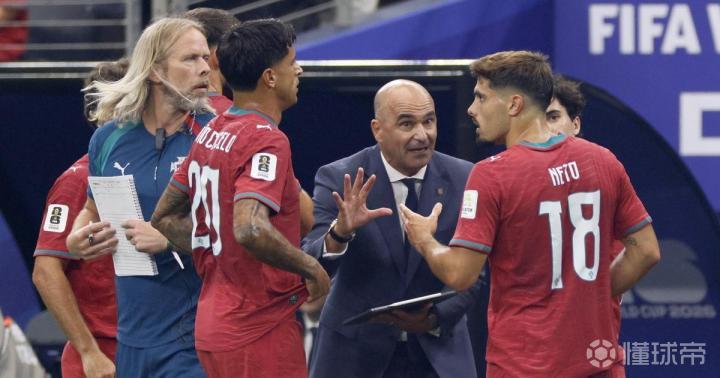
Roberto Martinez took over as manager of the Portuguese national team in early 2023, carrying the aura of a master strategist in international football. The Portuguese Football Federation leadership gave him a clear mission: to develop, organize, and lead the most brilliant generation of players in Portuguese history in a bid for the 2026 World Cup title.
On paper, the plan was almost perfect and flawless, but the harsh reality of the North American arena shattered the script meticulously crafted in the office. Portugal's early exit in the round of 16, facing a composed and deadly Spain, and their fall in the final moments of the match signaled the failure of a grand plan, which was ultimately brought down by its own mistakes and structural oversights.
Portugal left this World Cup with a painful and uneasy feeling: wasted opportunities were related to some of the coach's choices, but the reasons for their defeat went beyond that. The 0-0 scoreline held until the first minute of stoppage time, when Merino's precise goal finally broke the deadlock. This goal shattered Portugal's fighting spirit and punished the team's long-standing inability to function as a cohesive unit.
Looking back at Portugal's journey in the United States is like uncovering the seven deadly sins committed by Martinez and not just Martinez. Incomprehensible technical choices, tactical chaos, poorly handled media controversies, and behind-the-scenes noise that undermined the team's stability all contributed to this collapse. The narrow 0-1 scoreline attempted to mask or mitigate the problems, but it was ultimately ineffective.
The first major flaw is that Martinez clearly couldn't integrate a group of top stars into a cohesive unit. Portugal came to the World Cup with the rightful status of one of the world's most formidable teams, as evidenced by the market value and reputation of the players in their roster.
However, while there are many star players, there are very few as a whole. Immense individual talent has never found a stable tactical ecosystem and cannot be amplified in an organized manner.
Portugal is more like a team that relies on individual brilliance, depending entirely on Ronaldo's individual talent, Leao's breakthrough, Diogo Costa's several miraculous saves in front of the goal, or Renato Vega's pure fighting spirit on the defensive line.
But Martinez lacked the art and vision to integrate these components into a fluid machine. Portugal's midfield was sluggish, and their attacking transitions were shockingly slow. Without a solid overall framework, pure talent was ultimately isolated in a barren wasteland of impoverished ideas.
Portugal's main attacking engine is performing terribly, which is the second unbearable burden in the team's baggage. We are worried to see some world-class stars who have just had great seasons and maintained high efficiency at their clubs showing a lack of technical skill for the national team.
Players like Vitinha, João Neves, and Bruno Fernandes arrived here as undisputed midfield engines, but what they presented on the field was a pale, tired, and tactically suppressed version of themselves, far removed from their usual creative brilliance.
The physical fatigue accumulated from the grueling schedule is very noticeable in the players' legs and minds, but perhaps a worse mistake is that some players are placed in positions they are not used to, or are given instructions that restrict their natural habits.
Bernardo Silva has publicly acknowledged the immense difficulty, admitting that taking on a position he has played far less for his clubs in his career is obviously very complex. The result is that Portugal's creative midfielder is completely oxygen-deprived, moving sluggishly on the pitch and unable to deliver quality passes to the forwards.
Martinez's most glaring tactical problem lies in his interpretation of Vitinha's role on the field. Vitinha became the driving force behind Paris Saint-Germain's two European Championship victories, delivering a very high level of performance under Spanish coach Enrique.
In Paris, Vitinha controlled the midfield more independently, taking on the role of orchestrating the attack and controlling the tempo. But in Portugal's starting lineup, this dominance was stripped away.
Martinez placed Bruno Fernandes in the same area, and the two players' tactical tasks and runs were too similar and too overlapping, which created incomprehensible mechanical clashes on the field.
Instead of complementing each other in creating opportunities, they often found themselves in similar areas for the entire 90 minutes, compressing each other's passing lanes and interfering with each other's attacking decisions and progression. Having lost the freedom to play as a focal point at his club, Vitinha became a shadow unable to control the game, a mistake that weakened the fluidity of Portugal's overall attack.
The lack of rotation and extremely rigid management of the 26-man roster were Martinez's fourth major mistake during his time in the United States. The short tournament format, coupled with the harsh heat, resulted in the coach overloading his regular players and sidelining valuable and physically fit players.
Strictly speaking, he used 22 players in this tournament, but the data reveals that his management of the substitutes was very poor.
Four players will go home without getting any playing time: goalkeepers Rui Silva and José Sá, center-back Gonzalo Inácio, and winger Gonzalo Guedes. A valid question remains: why were Inácio and Guedes completely excluded when the team sometimes needed solutions?
Looking at the management of the attacking line, the questions deepen. In 450 minutes of potential playing time across five matches, Gonzalo Ramos played a paltry 35 minutes. There have been constant calls to give him opportunities, as he consistently responds with goals, such as his substitute appearance and winning goal against Croatia in a 2-1 victory. But against Spain, he didn't even play. Trincão played only 26 minutes, Samu Costa 20 minutes, and Matthäus Núñez a mere 1 minute.
Conversely, the five players used the most were heavily worn out. Diogo Costa and Renato Vega both played the full 450 minutes and were among Portugal's best performers in this World Cup. The goalkeeper performed brilliantly against Colombia and Spain, and the center-backs were excellent at limiting the opposition's attacks but struggled with distributing the ball.
The 41-year-old Cristiano Ronaldo has played a total of 441 minutes, Bruno Fernandes has played 422 minutes, and Nuno Mendes has played 398 minutes. Even though he was clearly struggling on the field with physical discomfort during the group stage match against Colombia, he still managed to contain Yamar well in the round of 16.
Off-field management and the atmosphere surrounding the delegation generated one of the most exhausting and absurd controversies during the Palm Beach training camp: media attention surrounding the players' beach trips. In Portugal, the public developed a severely distorted impression that the national team spent all their time on the beach, as if on an endless summer vacation, neglecting their competitive focus.
The situation became heated when Ruben Diaz accused journalists of amplifying the controversy and creating malicious noise. However, the fact is that on the second working morning in Palm Beach, the Portuguese Football Federation's press team formally invited print and photojournalists to photograph the players' so-called "physical activation," precisely on the sandy beach.
What further exacerbated the inconsistency in the players' protests was that the players themselves also posted numerous photos and videos of these leisure moments on their personal social media accounts. Those who should have been building a protective wall for the team and preventing easy public interpretation instead created a dangerous illusion and a highly ambiguous narrative.
The problems of this Portuguese national team extend beyond the pitch, clearly into the offices and internal politics. Since Pedro Proenza took over as president of the Portuguese Football Federation, it has become increasingly clear that the new management's plans do not include keeping Roberto Martinez as coach.
The Spanish coach was the personal choice of former president Fernando Gómez, and as publicly available information at the time indicated, he was also the second option after José Mourinho rejected the FA's offer.
Winning the UEFA Nations League title in 2025 ultimately saved Martinez's job as manager, dashing hopes of an immediate change before the World Cup. However, harmony and understanding never returned between the coaching staff and the management led by Proenza.
This rift was fully exposed in the huge differences in the public statements made by the two sides throughout the tournament: Pedro Proenza demanded that the team reach the semi-finals, while Martinez used defensive rhetoric, only talking about advancing from the group stage and taking it one step at a time.
The final charge touches on the most media-covered figure in Portuguese football: Cristiano Ronaldo, and his sometimes absent captaincy within the team. While it must be admitted that during a month-long training camp, with 27 players confined to the same environment, rock-solid unity and a pure "family" concept are nothing but naive myths.
Anyone who deals with a team of dozens of people knows that besides the players, there are coaching staff, personnel, security, media, and management, making the formation of cliques and naturally close relationships inevitable. Those who disagree or believe this isn't the case should first ask themselves this question. The real problem arises when the top leader occasionally becomes disconnected from the team's overall reality.
During training camp and matches, the internal atmosphere was affected by some minor discontent. This discontent stemmed from Ronaldo's somewhat arrogant attitude and deliberate aloofness when facing most of the team members. These subtle details and actions of maintaining distance created small cracks and resentment in a locker room filled with many young stars, who are also important figures in Europe's top clubs.
Although these traces are temporarily concealed when entering the stadium for a major battle, the fact is that they still leave a small lingering effect on team chemistry, affecting the tactical fluidity and psychological empathy that an elite team must possess to win crucial matches.
In summarizing this sorrowful farewell, it must be emphasized that the Portuguese players clearly gave their all on the field, striving and pushing themselves to the absolute limit.
However, for the reasons mentioned above, this limit is clearly still insufficient for a competition of this level and with such requirements. The 0-1 loss to Spain, with the score difference narrowed to a minimum in the final moments, is highly deceptive to the untrained eye, masking tactical flaws.
If the players are in peak physical condition and properly positioned in their most natural roles, this team's competitive ceiling is far higher than what people see on the American pitch. More importantly, this national team possesses individual ability and pure talent, making it one of the best squads in the world. However, the lack of a clear overall identity and the constraints of rigid management dogma ultimately led to Portugal's early elimination from the World Cup.
As the final whistle blew, Cristiano Ronaldo's tears soaked the Dallas pitch, cleansing the soul of a captain. He knew he was writing the final chapter of his World Cup career. Now, in this American desert, a question tinged with pain and respect echoes, and will be etched into history: Cristiano, how many of your tears were tears for Portugal?
Martinez, and not just Martinez's seven deadly sins, have cost Portuguese football dearly. With the Spanish coach expected to leave, a new chapter is about to begin. Many things must change, or Portugal will miss the opportunity to maximize the potential of this generation of brilliant players.